The motion pictures of the 1896 Melbourne Cup
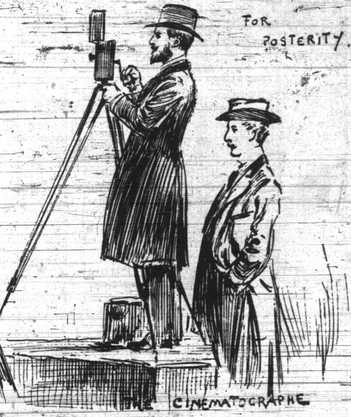
Sestier and Barnett at the Melbourne Cup Day races, as portrayed by The Bulletin's artist17
Image courtesy of the National Library of Australia
On Saturday, 31 October 1896 (Derby Day) and on Tuesday, 3 November 1896 (Cup Day), Marius Sestier and H. Walter Barnett shot films of events at the Victoria Racing Club (VRC) Spring Meeting at Flemington Racecourse, Melbourne, Victoria, Australia.1 These films are almost the very first ones taken in Australia, and those that are extant are (possibly) Australia's oldest existing motion pictures. Although films were taken on both the day of the Victoria Derby and the day of the Melbourne Cup, the collection is (and was) commonly referred to as "the Melbourne Cup films".
How many films did Sestier and Barnett take on these two occasions? Considering that some of them were not successfully processed, we are unlikely ever to know the answer to this question.13 But how many films were good, how many did they eventually show to the public, what were these films, and which ones still exist? And what were the logistics of their production?
One of the Melbourne Cup films was first shown on 19 November 1896 at the Princess' Theatre in Melbourne, Victoria2,3 as part of a theatrical matinee in aid of a fund for the Royal Victorian Institute for the Blind set up by Lady Brassey, the wife of the Governor of Victoria. It was of the arrival of Lord and Lady Brassey and the vice-regal party at the Flemington racecourse on the day of the Melbourne Cup. The audience received it enthusiastically, especially when the orchestra in the theatre played the National Anthem, as it was played by the band at the racecourse at the event shown in the film.3 (This was thus a very early experiment in synchronised sound!)
Sestier and Barnett returned to Sydney, New South Wales (where Sestier had exhibited his
Lumière cinématographe in September and October) soon after.
On Tuesday, 24 November 1896, at the Criterion Theatre, they showed several
of the films taken in Melbourne.4,5
The first advertisements for these shows stated that
15 Tableaux of the MELBOURNE CUP from the arrival of the GOVERNOR to the finish
of the last race
would be presented.
It was to be A COMPLETE RECORD OF THE CUP CARNIVAL of 1896
.4
The first advertisements for these shows to have a programme6 listed the following 11 subjects from the Melbourne races [my numbering]:
- Arrival of Train, Hill Platform
- The Lawn near the Band Stand
- Arrival of H.E. Lord Brassey and Suite
- The Saddling Paddock
- Finish of Hurdle Race, Cup Day
- Weighing-out for the Cup
- Finish of the Race
- Lady Brassey placing the Blue Ribbon on "Newhaven"
- Near the Grandstand
- Afternoon Tea under the Awning
- "Newhaven," his Trainer, W. Hickenbotham, and Jockey, Gardiner
So the number of Spring Meeting films was reduced by 4. Were there originally to have been 15 Melbourne films, or 15 films in total and the first advertisements were incorrect?
The most extensive review of this first public showing was given in The Daily Telegraph of 25 November;7 this review referred to all the Melbourne films listed above except [9] Near the Grandstand – i.e. only 10 films. The Sydney Morning Herald's review8 of this first showing specifically referred only to the titles numbered 11, 3, 8, and 7 (in that order).
But from 26 November, the advertisements said 10 LIVING TABLEAUX of FLEMINGTON
on CUP DAY, and 5 other magnificent pictures, included in each programme.
9
(There were to be no further lists of titles in the Sydney papers.)
Were these 10 all those listed above except number 9, as referred to in
the Telegraph review?
And by 5 December, the number of Flemington films on show was down to 6 (with 10 others).10 Presumably Sestier and Barnett adjusted their programmes in response to the receptions of the films by their viewers; or maybe some of the prints became damaged and could not be successfully run through the cinématographe. From 9 December, no number of Melbourne films was given in advertisements.
There was also mention of films that appear not to have been shown.
The advertisement in The Sydney Morning Herald of 21 November4
refers to Special pictures of NEWHAVEN with his Jockey and Trainer before and
after the CUP
[my emphasis],
and in the notices in the same paper5 and in Sydney's The Evening News
of the same date,20 the departure of the
vice-regal party was supposed to have been on the programme.
It thus appears that some of the films were not considered to be worth showing
publicly even once (or the advertisements were incorrect).
An early announcement18 that a Lumière cinématographe was to be exhibited
in Adelaide, South Australia refers to the 16 original [pictures] so successfully
taken by Messrs. Barnett and Sestier, of the Derby Day and the Melbourne Cup
.
(This is the only time the number of films was 16, and the number is most likely a typo.)
When it was exhibited at the Theatre Royal in Adelaide at the end of 1896,
several of the Melbourne Cup films were referred to by name in the newspaper advertisements:11
Derby Day (the Betting Ring)
Arrival of Train at Flemington
Arrival of Lord Brassey and Party on the Lawn
Finish of the Melbourne Cup Race
on the Lawn, near Grand Stand
The first of these, Derby Day (the Betting Ring), had not been mentioned in earlier advertisements, and specifically refers to the Victoria Derby (assuming that it was in fact made at Melbourne).
A few days later, another list was advertised for Adelaide:12
Arrival of Train, Melbourne Cup
Arrival of Lord and Lady Brassey and Suite
The Grand Stand
Weighing for the Cup
Finish of the Melbourne Cup Race
Decoration of Newhaven, Derby Winner
Newhaven, his Trainer, and Jockey
Presumably, these are films numbered 1, 3, 9, 6, 7, 8, and 11, respectively, above.
The film of Lady Brassey putting the blue ribbon around Newhaven's neck (number 8 above) is here explicitly connected with the Victoria Derby: this blue ribbon was given in recognition of the Derby winner. Some newspaper articles that mention the 'blue ribbon' film erroneously imply that it was taken at the Melbourne Cup; the fact that Newhaven won both the Derby and the Cup in 1896 has caused the confusion.
After Sestier had left Australia in May 1897, one of his cinématographes was
exhibited in Brisbane, Queensland, and the Melbourne Cup films were often shown.
One review states that, in all, twelve different views of Flemington on Cup Day
14
were available to be shown.
A later advertisement15 promises the MELBOURNE CUP FROM START TO FINISH
, and
lists the films to be shown:
Arrival of the train at Hill platform
Arrival of Lord and Lady Brassey at Flemington
On the Lawn, near grand stand
Saddling paddock
Start of Cup race
Finish of the Cup race
Lady Brassey placing the Blue Ribbon on Newhaven
Newhaven, his Trainer, Higginbotham, and Jockey, Gardiner
A film of the start of the Melbourne Cup had not previously been referred to in any Sydney, Melbourne, Adelaide, Perth, or other newspaper. However, it is almost impossible that Sestier could have filmed the start of the Cup race, reloaded his cinématographe, and proceeded to beyond the finishing post and set up to film again in the 3 minutes or so of the race. (If someone else was filming with another cinématographe, then both start and finish could have been shot – but there is no evidence for another Lumière cinématographe being in the country at this time.)
But there could be confusion. We have The Lawn near the Band Stand (number 2) and [On the Lawn] near the Grand Stand (number 9): were there two films, or just one, with the names being (easily) confused?
What films were made?
The following films were explicitly named in advertisements or referred to in reviews or reports:
Derby Day films
- Derby Day (the Betting Ring)
- Finish of the Victoria Derby
- Lady Brassey placing the Blue Ribbon on "Newhaven"
Melbourne Cup Day films
- Arrival of Train, Hill Platform
- The Lawn near the Band Stand
- [On the lawn,] near the Grand Stand
- Arrival of H.E. Lord Brassey and Suite
- The Saddling Paddock
- Finish of Hurdle Race, Cup Day
- Weighing-out for the Cup
- Start of the Melbourne Cup Race
- Finish of the Melbourne Cup Race
- Weighing-in for the Cup
- Afternoon Tea under the Awning
- "Newhaven," his Trainer, W. Hickenbotham, and Jockey, Gardiner, after the race
- Departure of H.E. Lord Brassey and Suite
- "Newhaven," his Trainer, W. Hickenbotham, and Jockey, Gardiner, before the race
Whether each of these was actually shot as a distinct film we are unlikely ever to know.
What films do we still have?
The following table lists the films that survive in the Lumière collection, with their numbers and names in the Lumière catalogue and their likely identifications with the films shown in Sydney.
| Lumière catalogue number | Lumière catalogue title | Title from Sydney programme | First showing |
|---|---|---|---|
| 418 | La foule | The Lawn near the Band Stand | 24 November 1896 Criterion Theatre, Sydney |
| 419 | Arrivée du gouverneur | Arrival of H.E. Lord Brassey and Suite | 19 November 1896 Princess' Theatre, Melbourne |
| 420 | Enceinte du pesage | The Saddling Paddock | 24 November 1896 Criterion Theatre, Sydney |
| 421 | Sortie des chevaux | Weighing-out for the Cup | 24 November 1896 Criterion Theatre, Sydney |
| 422 | La course | Finish of the Melbourne Cup Race* | 24 November 1896 Criterion Theatre, Sydney |
| 423 | Présentation du vainqueur | "Newhaven," his Trainer, W. Hickenbotham, and Jockey, Gardiner, after the race | 24 November 1896 Criterion Theatre, Sydney |
| 652 | Arrivée d'un train à Melbourne | Arrival of Train, Hill Platform | 24 November 1896 Criterion Theatre, Sydney |
(The hyperlinks are to copies of the films at the australianscreen Web site.)
* The National Film and Sound Archive of Australia, in their collection catalogue, have copied the erroneous identification of this film by the authors of La production cinématographique des frères Lumière19 as Finish of Hurdle Race, Cup Day. This is wrong because in the film the first and second horses are several lengths apart at the end, but in that day's Hurdle Race there was only 3/4 of a length separating them; and there is not a single hurdle visible on the track.
But could not "La foule" be Near the Grand Stand, if this was indeed a different film? And "Weighing-out for the Cup" is more likely to be Weighing-in for the Cup as it appears that the horse and jockey have just come off the racetrack. (Weighing out is done before a race, and weighing in after a race.)
Regarding the sequence of Lumière catalogue numbers, why does the "arrival of a train" film have a number that is not consecutive with the rest? La production cinématographique des frères Lumière22 states that, in general, the numbering of the films corresponds to the times of their arrivals at the Lumière offices; if this is indeed so it means that there was a delay between the receipts of the train film and the others. Did Sestier (or someone else) really send them separately, and if so, why?
Further notes on the films
The lawn near the band stand
In the VRC's advertisements26 for activities on both Derby Day and Cup Day in 1896 the following notice was given:
The AUSTRALIAN MILITARY BAND,The position of the band on the Lawn is not known. (In the various still photographs taken on Derby Day and Cup Day, including panoramic ones, nothing resembling a band can be discerned.) Presumably Sestier's cinématographe was set up near the band, if the title of the film is correct; considering that the camera was raised above ground level maybe it was set up on the band stand itself.
Under the direction of Signor ZELMAN,
Will Perform on the Lawn
It has been asserted, without any evidence or justification being presented, that Marius Sestier himself appears in this film. But the person identified as Sestier is definitely not him.27
In Sydney's The Bulletin of 23 March 191129 there is an interesting article by someone using the nom de plume of "Lafayette" which refers to the shooting of the Melbourne Cup films:
[...] "The Lawn on Cup Day" was a funny film. In those days the film was only 65ft. long, and ran for a minute and a quarter. Sestier turned the handle, I steered the people away from the front of the camera (everybody wanted to stop and look into it), and Barnett "stage-managed," as he called it. He had got himself up in a most conspicuous costume for the day. When the machine started, he walked straight up with Mrs. Brough, acting and talking for all he was worth; dropped her, raced back through the crowd, grabbed Mrs. Maesmore Morris, marched her up, tore back, and repeated the performance with the wife of a Melbourne sharebroker. [...]Although there are several errors in the article as a whole, the fact that the author claims to have been involved with the filming at the 1896 Melbourne Cup is significant. And, if he is to be believed,
Sestier turned the handle.
Arrival of H.E. Lord Brassey and suite
From newspaper reports, the vice-regal party arrived at about the time of the start of the Hurdle Race, which was the first race of the afternoon and was scheduled for 1 p.m. The members of the party arrived in four carriages. In the film the last of these carriages is seen to stop in the background, but most activity on it is hidden by the dense crowd, in the foreground, waiting for the governor and suite to walk up a section of lawn that is kept clear by attendant policemen.
From the shadows seen, the Sun is to the right of the camera position, and the direction of view is roughly west-southwest.
The saddling paddock
Several horses are seen in this film but none of them is Newhaven, the winner of the Victoria Derby and the Melbourne Cup, who would be distinguishable by his long blaze.
The building in the background has, on the right, above the apparently louvred windows, the label "GENTLEMEN".
Weighing-out for the Cup
(Or, more likely, Weighing-in for the Cup.) The horse that is ridden into the scene and is in centre frame for most of the film is not Newhaven, as he does not have Newhaven's long blaze.
Finish of the Melbourne Cup race
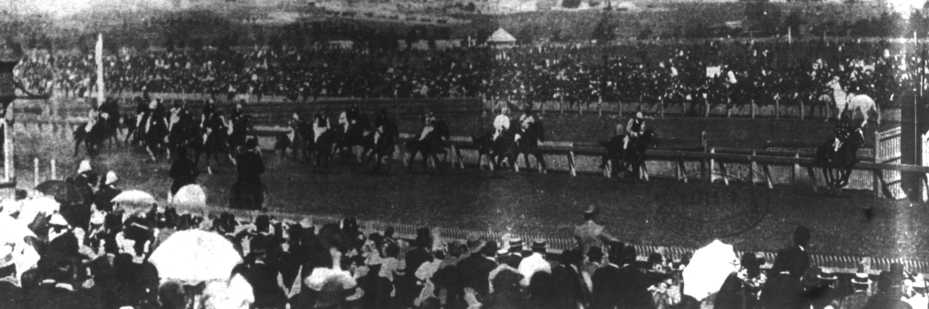 Image courtesy of the National Library of Australia
The image above, a detail from page 912 of the 7 November 1896 edition of The Australasian weekly newspaper, shows the positions of the horses at the finish of the race for the 1896 Melbourne Cup. Although Sestier and Barnett's film was shot from a point some way to the right of this scene, the positions of the horses in the film, taking parallax into account, coincide with those in this image.
Why didn't Sestier and Barnett set up their cinématographe closer to the finishing post, with a view similar to that above? Would the horses be moving so fast, when viewed laterally, that their images would be blurred because the cinématographe's exposure time couldn't be set short enough?
And although Barnett managed to whip up some hat-waving enthusiasm in the vicinity of the camera, only one raised hat can be seen in the image above.
"Newhaven," his Trainer, W. Hickenbotham, and Jockey, Gardiner, after the race
Newhaven is saddled, the winning jockey, Henry James Gardiner is helped up, and they are walked around in a tight circle by trainer Walter Hickenbotham. After one loop they stop and look out, wondering what to do next. They are obviously asked to do another loop, which they then execute.
When this film was shot is not known. It probably wasn't taken after the Derby race, because Gardiner was reported to have gone home soon after winning.28 As there is little shadow to be seen, it appears unlikely that it was filmed after the Melbourne Cup race, which was run on a sunny day – unless the location was shaded (possibly by trees) or clouds had formed.
Arrival of train, Hill platform
The film shows two trains and a locomotive in motion, and two platforms are visible, one on each side of the railway tracks. The camera is positioned on the north platform (as determined by the direction of the shadows in the image) and facing roughly north-east, and the main subject of the film is the arrival of a train at this platform and the alighting of passengers from it. But the film starts with the other train, only just in view, coming to a stop at the other, south, platform. As the north platform was referred to as the Hill platform and the south platform as the Grand Stand platform, the title Arrival of Trains at Hill and Grand Stand Platforms, which was once used in an advertisement,4 is valid for this film alone and doesn't refer to two distinct films.
How do we know that this film was made on the day of the Melbourne Cup, and not on the Victoria Derby day (or even on another day of the Spring Racing Meeting)? The weather on the day of the Derby was reported to have been bleak and cold, and few spring dresses were to be seen.
| The image on the right is a copy of the last photograph in the book
Views at Flemington: Melbourne Cup 1894 (see below),
titled Train Arriving at the Course,
and is taken on the Grand Stand (south) platform with the camera facing roughly south-west.
The rear of the racecourse Hill Stand is seen in the background.
A portion of the Hill platform is visible in the middle distance on the right,
and on it is a small, roofed structure with an elevated section that was probably
an observation post for the railway.
(There is a similar one opposite it on the Grand Stand platform.)
To account for the elevated position of the camera in the train arrival film,
it is likely that Sestier shot it from this building.
The light-coloured section in the fence behind and to the left of this structure is a gateway; although barely visible in this reduced-size image, across the top of this gate it reads "TO THE HILL". | 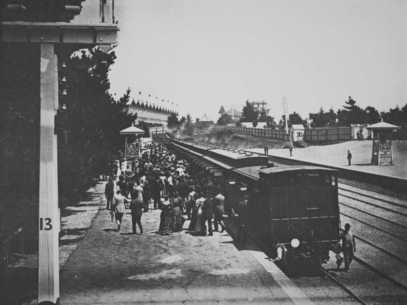
Image courtesy of the National Library of Australia
|
H. Walter Barnett's "star" performances
In three of the surviving films, H. Walter Barnett makes himself conspicuous: The Lawn Near the Band Stand; The Saddling Paddock; and Finish of the Melbourne Cup Race. In the first of these, he walks from the camera position into the crowd and talks to various people and directs them to walk closer to the camera, sometimes accompanying them as they do so. He manages two such sorties in the time of the film. In the second, he again walks out before the camera to talk with a couple, but the appearance of a somewhat unruly horse interrupts them, and when the horse has the audacity to stop and stand between them and the camera, HWB has to give it a nudge to leave the scene! In the film of the finish of the race, the collection of people standing near the barrier rail do not appear to be very excited about the horses coming down the straight, so once again Mr. Barnett walks into view and tries to get them to show some interest by waving their hats; he is partially successful.
Barnett's appearances didn't go unremarked:
"Well-known figures pass and re-pass in living semblance to their very selves, prominent amongst them being the ubiquitous Mr. Barnett himself, to whose enterprise is due this triumph of up-to-date living pictures."23and
"The Australian pictures are keenly appreciated, and the frequent appearance in them of Mr. Barnett, who seems to be manipulating the crowd after the manner of some great general, is not without its effect on those amongst the audience who recognise him."24
The well-known people in the films who were named in newspapers were Robert and Mrs. Brough, Mr. G.S. Titheradge, and Tom Fitzgerald. The NFSA have identified some of these, as well as members of the vice-regal party, in Spotted at the 1896 Melbourne Cup Carnival. Mrs. Maesmore Morris is also named in an article written 15 years later.29
Did Barnett have something wrong with his left arm or hand at the time the films were shot? In The Lawn Near the Band Stand and The Saddling Paddock, for most of the time he is on screen he keeps his left arm bent at the elbow and by his side and does not move it, but uses his right hand normally. And in Finish of the Melbourne Cup Race his left hand is in his trousers pocket for the whole scene.
And HWB gets a late chance for glory in Simon Wincer's 2011 film The Cup about the 2002 Melbourne Cup race. At the start of this film very brief clips are shown from The Lawn Near the Band Stand, Arrival of H.E. Lord Brassey and Suite, and Finish of the Melbourne Cup Race; in the first of these we see H. Walter Barnett for about one second.
Production of the films
In November 1896, there was only one Lumière cinématographe in Australia. There are many mentions of "the only authorised cinematographe in Australia" in newspaper advertisements and reports. And had there been another machine surely it would have been used for exhibitions. (A second one arrived in Sydney on 11 December.) Some histories state that Sestier arrived with 2 machines, but no evidence is given; it was probably assumed he brought two because two were bought by Baker and Rouse, Limited after Sestier finished in Australia.25
Exactly how was the first display (positive) print, that was shown at Lady Brassey's benefit matinee, made? Processing a 17 m length of film had only recently been accomplished for the first time in Australia at Barnett's Falk Studio in Sydney. Also, almost two weeks elapsed between taking the films and an announcement that the processing (of most of them) had been successful.13 As a Lumière cinématographe would function as a camera, printer, or projector, there are several possible answers to this question, listed below in order of increasing organisational and technical difficulties.
- Sestier and Barnett used available processing equipment in Melbourne to develop the negative and make a display print using the cinématographe they had there. (There was a Falk Studio in Melbourne as well as one in Sydney.)
- Sestier and Barnett took the necessary processing equipment to Melbourne, and developed the negative and made a display print using the cinématographe there.
- The negative was sent to Sydney, developed, sent back to Sestier who used the cinématographe to make a positive, which was in turn sent to Sydney for developing, and the resultant display print was sent to Sestier!
- The negative went to Sydney, where someone somehow managed to make a positive copy without the use of a (Lumière) cinématographe.
- The cinématographe itself was taken back to Sydney one Sunday, when there was no exhibition, to make the positive print. (This assumes of course that there were express trains running at appropriate times.)
The last three possibilities are in agreement with the recollections of Albert James Perier,16 who stated that the Melbourne Cup films were developed in Sydney. But he doesn't say where the films were printed.
Decorating the Derby winner
The film of Lady Brassey placing the Blue Ribbon on "Newhaven" taken following the 1896 Victoria Derby race has not survived, and we do not know from where Sestier filmed the ceremony. The image below purports to show Newhaven being decorated, and within the cyan rectangle are seen a woman's head on the left and an unmounted horse on the right, so presumably these are the two "stars".
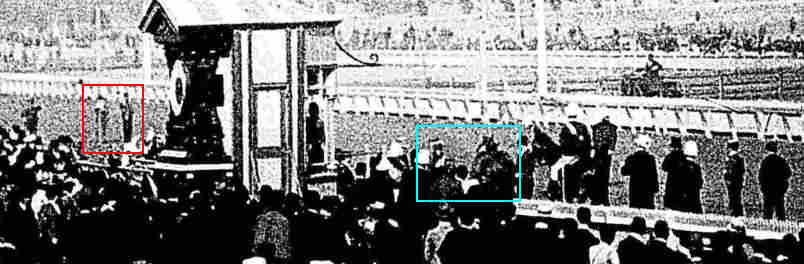
Decorating the 1896 Victoria Derby winner
But who are the two persons on the course, indicated within the red rectangle? Could these be Sestier and Barnett in the process of filming the event? Unfortunately the half-tone original image gives poor resolution, and with the small size of the figures it is impossible to identify the two and know what they are doing. If (a copy of) the original photograph can be found it might be possible to get a better idea of what is going on.
Antecedents for the subjects of the films
Two earlier groups of works are interesting to compare with the Melbourne Cup films: the three paintings by Carl Kahler,
- The Lawn at Flemington on Melbourne Cup Day (1887)
- The Betting Ring at Flemington (c.1889)
- The Derby Day at Flemington (c.1889)
The Kahler paintings, which were later reproduced by Goupil et Cie as photogravure
prints for wider distribution,
are in the first instance representations of large numbers of persons, some of whom,
apparently, paid to have their image in a painting.
The settings show the appearance of some of the racecourse buildings and grounds at the time.
Interestingly, amongst the items of Barnett's house contents auction on
8 September 1896 are listed Photogravures by Goupil and Co.
and Bougereau
:
were the Goupil ones of the Flemington scenes?
More relevant as a comparison with Sestier and Barnett's films, however, are the photographs in the 1894 Sands & McDougall volume. The titles of these are:
- The Committee of the Victoria Racing Club, 1894
- The Officers of the Victoria Racing Club, 1894
- Members’ Drive - Arrival of His Excellency the Governor
- Lawn and Stand
- Grand Stand Terrace and Scratching Board
- Terrace. Grand Stand
- Weighing in after the Cup
- View of Grand Stand and Hill from the River
- Lawn and Fountain
- The Governor’s Luncheon Room
- Under the Elms - Members’ Reserve
- Derby Start
- Derby Finish
- General View from the Hill
- Members’ Drive
- Entrance to Grand Stand from Railway Station
- View of Grand Stand and Hill from the Lawn
- Train Arriving at the Course
References and notes
[1] 16 November 1896, The Age (Melbourne), p.6g, Amusements.
During the recent racing festival at Flemington the Lumiere Cinematographe was used for the first time in this part of the world to secure moving pictures of the Derby, the Cup race, and numerous scenes on the lawn. It was chiefly in the nature of an experiment, but many will feel gratified to know that most of the principal views taken have been successfully developed. When these are shown, as they will probably be next week, it is safe to say that they will attract considerable attention, for by this means those who witnessed Newhaven's double triumph will be able to enjoy the sight over again, and those who did not see it will now have an opportunity of so doing, through the medium of this wonderful instrument. Besides this there will be various pictures of promenaders on the lawn, including the arrival of the vice-regal party. [...]
There were two other days of the Spring Meeting, Oaks Day on Thursday, 5 November and Steeplechase Day on Saturday, 7 November; no mention has been found of Sestier and Barnett filming at Flemington on either of these days.
[2] 19 November 1896, The Age, p.8h, Amusements.
This advertisement refers to only one film:
The FIRST LOCAL PICTURE Taken by the Lumiere Cinematographe, Showing FLEMINGTON ON CUP DAY,
And THE ARRIVAL Of HIS EXCELLENCY the GOVERNOR and Suite on the Course
.
[3] 20 November 1896, The Age, p.6g, Royal Victorian Institute for the Blind, Lady Brassey's Appeal.
This review states that there was one picture that was new,
that of the arrival of Lord and Lady Brassey and party at Flemington.
[...] the Lumiere Cinematographe views were shown. They included a new picture, illustrating the arrival of Lord and Lady Brassey and the vice-regal party at Flemington racecourse on Cup day. It was a wonderful and faithful photograph, the scene being reproduced with the most perfect fidelity, and all the bustle and animation of the racecourse being brought before the audience with the same vividness as if they were looking upon the actual moving figures. When the orchestra, in imitation of the invariable custom of the band at Flemington at the moment of the arrival of the viceregal party, struck up the National Anthem, the audience in the theatre rose to their feet and cheered heartily, just as the crowd on the racecourse cheered on the occasion represented, thus completing the reproduction in the vocal detail to which the cinematographe has not yet been educated. [...]
[4] 21 November 1896, The Sydney Morning Herald, p.2a, Amusements, Criterion Theatre.
[5] 21 November 1896, The Sydney Morning Herald, p.10e, Amusements, Lumiere's Cinematographe.
[6] 24 November 1896, e.g. The Sydney Morning Herald, p.2d, Amusements, Criterion Theatre.
[7] 25 November 1896, The Daily Telegraph (Sydney), p.6c, Amusements, Lumiere Cinematographe.
AUSTRALIAN SCENES.
Messrs. Marius Sestier and H. Walter Barnett are revisiting Sydney with their wonderful Lumiere Cinematographe and a fresh collection of pictures, most of which are of strong local interest. [...] The pictures which were brought with this cinematographe to the colonies were beautiful and wonderful, but Messrs. Sestier and Barnett are keeping pace with the times, and during their absence have enriched their collection with a large number of purely Australian scenes. That great intercolonial carnival, "The Melbourne Cup," furnishes most of the pictures exhibited in the present entertainment, and they strikingly convey the marvellous accuracy of the new photography. First of all there is the arrival of a laden train at the Hill Platform, Flemington. All who had been "at the Cup" recognised the scene, and the view received a storm of applause. Then followed in quick succession the lawn and band stand, with the bustling, fashionably attired crowd; the arrival of Lord Brassey and suite, with all the well-known formalities; the saddling paddock, with the racehorses walking "as natural as life," under the critical eyes of experts; and the finish of the Hurdle Race on Cup Day. As the familiar and stirring events passed in review a little of the excitement of the racecourse seemed to seize on the audience, and this grew as the horses were weighed out for the Cup, and Newhaven went forth along with the animals it was his good fortune to defeat. The finish of the race was watched with intense interest, and something like a little cheer went up as Newhaven swept past the post, although the horses were too far off to be clearly distinguished. Lady Brassey was then seen placing the coveted blue ribbon on the winner, after which a sight of afternoon tea under the awning was afforded. A moving picture of Newhaven, with his trainer, Mr. W. Hickenbotham, and his jockey, Gardiner, completed this portion of the exhibition. The audience found a vast fund of amusement in picking out well-known faces as they occurred in the throngs, and, indeed, quite a society column of "those present" might be written if space permitted. [...]
[8] 25 November 1896, The Sydney Morning Herald, p.8b, The Lumiere Cinematographe.
The prominent feature in the new tableaux which were shown before a large audience at the Criterion Theatre last night consists in the fact that all the pictures but two represent Australian scenes. M. Marius Sestier has been enabled thus to enrich his repertoire by the skill of Mr. H. Walker [sic] Barnett ("Falk"), who with complete success has secured a long series of views of the Melbourne Cup, in which the figures of well-known citizens of Sydney and the sister capital appear. The scene at the Criterion which caused most delight was a splendid picture of Newhaven, notable for his fine head and glossy coat, being led up and down by his trainer, with Gardiner up. There was also a remarkably clear view of the arrival of the vice-regal party on the course. Constables were seen, telling the crowd to "stand back," and then Lord Brassey advanced with Lady Brassey on his arm. The portraits were life-like and all the members of the party successively came to the front in accurate focus. Lady Brassey placing the Blue Ribbon upon the unruly Newhaven, who eventually plunged and reared right out of the scene, was another tableau which excited enthusiasm; and the horses at the finish of the great race itself, and other incidents of Cup Day, were shown. [...]
[9] 26 November 1896, e.g. The Daily Telegraph, p.2a, Amusements, Criterion Theatre.
[10] 5 December 1896, The Sydney Morning Herald, p.2f, Criterion Theatre.
[11] 28 December 1896, The Advertiser (Adelaide), p.2a, Amusements, Theatre Royal.
[12] 2 January 1897, The Advertiser, p.2a,b, Theatre Royal.
[13] 16 November 1896, The Age, p.6g, Amusements.
This report - see [1] above - says developed
:
is this really what was meant, or does it mean that positive prints were also made?
[14] 28 May 1897, The Brisbane Courier, p.6d,e, Amusements.
[15] 19 June 1897, The Brisbane Courier, p.2e, Entertainments.
[16] 9 June 1922, The Sydney Morning Herald, p.9f, The Kinema.
[17] 14 November 1896, The Bulletin (Sydney), p.15 (detail).
This detail is from the top right of the page, the whole of which is taken up with
illustrations by
Percy F.S. Spence.
The page is titled AT MELB. CUP.
[18] 8 December 1896, The Advertiser, p.5g, Amusements, Theatre Royal Attractions.
[19] Michelle Aubert and Jean-Claude Seguin, La production cinématographique des frères Lumière; la Bibliothèque du Film, Paris, 1996; p.57.
[20] 21 November 1896, The Evening News (Sydney), p.3e, Amusements, Lumiere's Cinematographe.
[21] Views at Flemington: Melbourne Cup 1894, Sands & McDougall Limited, Melbourne, 1894; National Library of Australia: MCL HIST 1262.
[22] Op. cit., p.29.
[23] 25 November 1896, The Referee (Sydney), p.7f, Footlight Flashes, Lumiere Cinematograph. [sic]
[24] 6 December 1896, Sunday Times (Sydney), p.2c, Before the Curtain, Criterion Theatre.
[25] National Film and Sound Archive of Australia: Title no. 224112: A.J. PERIER : INTERVIEW. (Undated)
[26] 31 October 1896, Argus, p.16f, Amusements, Victoria Racing Club.
2 November 1896, Argus, p.8d, Amusements, Victoria Racing Club.
[27] The image on the left below is a detail from a contemporary studio portrait of Sestier taken at Henry Walter Barnett's Falk studio; Sestier is dressed in the same clothing he is seen wearing in a portrait of him that was published on 10 October 1896 in Sydney's The Bulletin magazine and it is reasonable to assume that these photographs were taken at the same sitting, and most likely within two weeks before the publication date. The image on the right is a detail from a framegrab from the video copy of the film.
Contemporary portrait of Marius Sestier

|  Person in film
|
There is a similarity between the faces in these images, but it isn't possible to be certain that they are of the same person, given the small sizes, difference in lighting, and poor image quality of the framegrab. What are nonetheless apparent are differences in the beards and moustaches seen in the two images: Sestier's beard hair does not appear to be very dense, and his moustache is turned up at the ends (and possibly waxed), while the person seen in the film appears to have denser facial hair and his moustache is not upturned. But this is hardly conclusive counter-evidence given that weeks had elapsed between the taking of the studio photo and Melbourne Cup day.
However, when looking at the filmed person "in motion" when the film is playing makes it much more obvious that his face does not really look like that of Sestier's.
Moreover, Barnett's clothing as portrayed in the drawing shown at the top of this article is a good match for what he is seen wearing in the film, yet the person who is claimed to be Sestier in the film has completely different clothing from that of the image of Sestier in the drawing. Admittedly, the persons illustrated in the drawing are not identified, though it is certainly Barnett shown on the right. But why would the other figure be of anyone but Sestier, as he was responsible for the presence of the Lumière cinématographe in Australia, and whose name was mentioned in most advertisements for its exhibition?
And if that is not enough to refute the claim of Sestier's film appearance, consider the behaviour of the fellow we see: he acts as someone who has absolutely no idea about what is going on: he walks away from the camera, turns around, and then spends the rest of the time we see him gawking toward the camera. He is completely bemused, which is not what Sestier would have been. (And consider H. W. Barnett in the film: he comes and goes quite nonchalantly.) The person identified in the film is not Marius Sestier.
[28] 2 November 1896, The Age, p.5g, DERBY DAY.
[29] 23 March 1911, The Bulletin, p.9a, POVERTY POINT
Added to the author's name is (from the inside)
, which probably indicates
that he was one of those directly connected with the cinematographe business
in its early days.
Who "Lafayette" was is not known, but he may well have been George Austin Brewster,
who ran a photographic studio in Melbourne with that name.
"Lafayette" claims to have shot films himself, though no other reference to Brewster
as a cinematographer has been found.
|
Copyright © 2010 – 2024 Tony Martin-Jones | FILM HISTORY INDEX |
Edition 7·1 (2024-12-04) [First edition in 2010-03] |